

When Content Arrives Ready to Fix, Not Ready to Use
It’s Monday morning at the content operations desk. A 24-episode season promised to be delivered by the producer delivered should be ready to go.
Then the QC report comes back.
- Ten master files have the wrong codec
- Three episodes don’t have closed-caption files
- Two are missing the right number of audio tracks
- The promo bundle is short some artwork images
- The metadata sidecar references a spec from a deal closed last year, not this one
The season has been “delivered,” but none of it is ready.
A Scaled-up Version of an Old Problem
Having to make that phone call back to the producer and start hunting down the right content is nothing new.
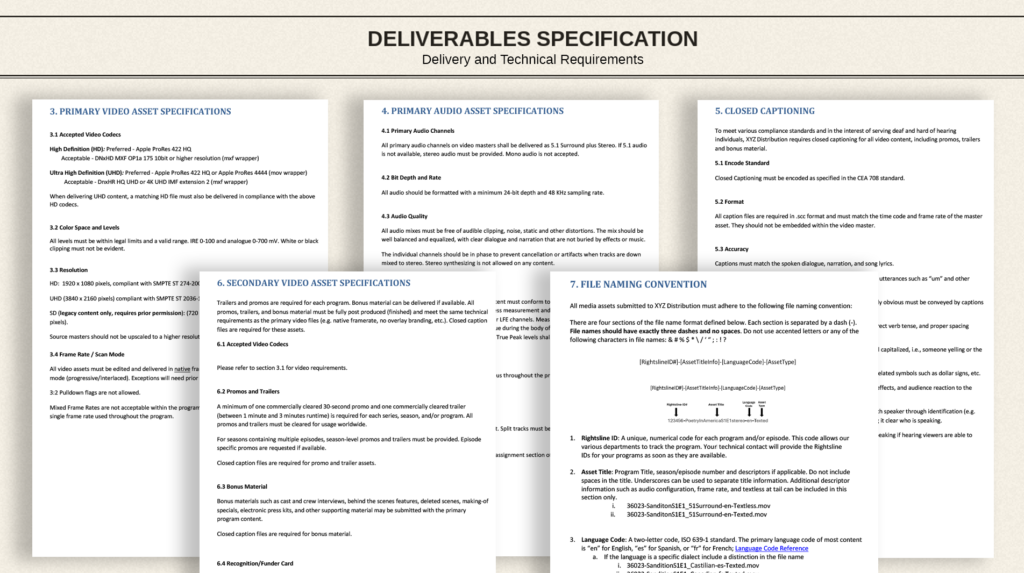
Broadcasters, streaming platforms, sports rights holders, and airline and hospitality content providers have lived with delivery quality problems for years. What has changed is volume. A single licensing deal can mean multiple seasons across multiple territories, each with audio, captions, artwork, promo cuts, and metadata governed by delivery specs that vary by recipient.
The industry has tried to standardize. The Digital Production Partnership’s AS-11 gave UK broadcasters a shared framework for file-based delivery. SMPTE’s Interoperable Master Format (IMF) was built to address fragmentation in master-file delivery. But standards work only when everyone implements them the same way, and they don’t. Suppliers deliver to dozens of recipients, each with their own variations and exceptions. The moment a supplier guesses wrong on color space, caption format, or a file naming convention — or just makes an honest mistake — the package gets flagged, after it has already moved across the network and into storage.
What It Actually Costs
Discovering the problem after delivery is the expensive part. By the time the QC report surfaces an issue:
For organizations receiving thousands of packages a year, even a low rejection rate translates to real operational drag. Customers describe it the same way every time:
- “Days later, we keep catching issues after content arrives.”
- “The producers mean well, but sometimes they miss things and send it anyway”
- “They have to keep sending new files and we have to QC it over and over “
- “We just have to take what we get”
None of those are technology problems. They are a control problem at the point of submission.
The Shift: Move Validation Upstream
The opportunity is to move validation upstream, before submission. If a supplier knows at submission that a file is missing or a spec is wrong, they can correct it before it consumes storage, disrupts a workflow, or becomes someone else’s problem.
This isn’t traditional QC. Editorial QC will always be part of the workflow. This is supply chain control: a check at submission that confirms content is complete and compliant before anyone else has to handle it.
Verify, Before Submission
This is why Signiant built Verify. Announced at NAB Show 2026 and coming soon, Verify is a control layer for inbound content.
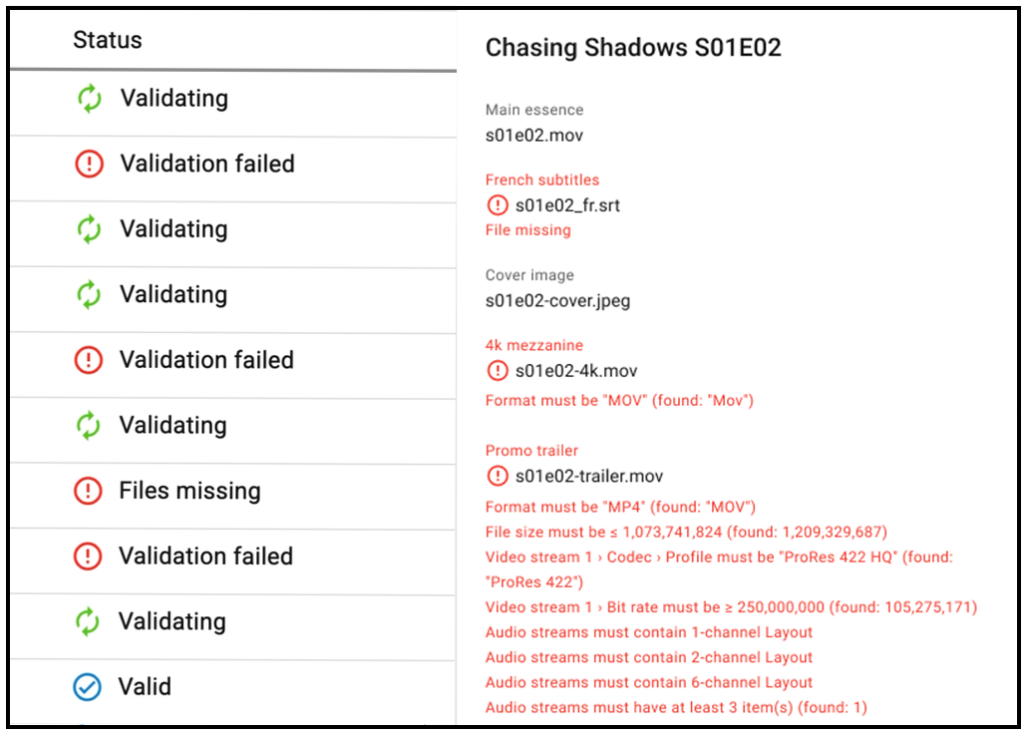
The receiver defines what a complete, compliant package looks like: required materials, technical specifications, and package structure. Verify turns those requirements into a manifest for the supplier.
As the supplier prepares and submits, each file is checked against the spec. Missing materials, non-compliant files, and incomplete packages are flagged at the moment of submission, not days later. Only validated packages move downstream.
The content supplier gets a chance to fix issues before anyone else has to, and the receiver gets a workflow that doesn’t begin with exception management.
What It Looks Like When It Works
For operations managers, Monday mornings stop being triage. The packages that land are the packages that are ready. Storage budgets stop absorbing content that was never going to make it through. Operators get their day back, doing the editorial and creative work they were hired to do.
For producers, the redelivery cycle stops. The 4 p.m. Friday QC report stops being something to dread. They become the partner who delivers right the first time, and the partner that receivers want to work with again.
The Monday morning question stays the same. The answer changes:
Did we get everything we expected? Yes.
Is it ready to use, or ready to fix? Ready to use.